
Three Days and Three Nights
The Biblical Timeline of Jesus’ Crucifixion and Resurrection
“As Jonah was three days and three nights in the belly of the great fish, so will the Son of Man be three days and three nights in the heart of the earth.”
Matthew 12:40
Why the Timeline Matters
The death, burial, and resurrection of Jesus Christ are the center of the gospel. Scripture does more than say that Jesus rose; it gives time markers that allow the events to be placed in order.
The key is to read the Gospel accounts according to the biblical calendar. A biblical day begins at sunset. Passover and the Feast of Unleavened Bread are distinct observances, and the week of the crucifixion contained both a high Sabbath and the regular weekly Sabbath.
When those details are placed together, the sequence points to a Wednesday crucifixion, burial before sunset, three full days and three full nights in the tomb, and a resurrection after the weekly Sabbath ended and before the women arrived early Sunday morning.
1. Begin With the Sign Jesus Gave
Jesus identified one specific sign: the sign of Jonah. Matthew 12:40 states that the Son of Man would be in the heart of the earth “three days and three nights.”
Friday afternoon to Sunday morning does not contain three full days and three full nights. The Wednesday-to-Saturday timeline does.
2. Understand the Biblical Calendar
- A day begins at sunset. The biblical calendar runs evening to evening, not midnight to midnight.
- Passover falls on Nisan 14. Leviticus 23:5 places the Lord’s Passover on the fourteenth day of the first month.
- Unleavened Bread begins on Nisan 15. The first day is a holy convocation in which ordinary work is not done.
- The approaching Sabbath was a high day. John 19:31 identifies the approaching Sabbath as a high Sabbath.
- The weekly Sabbath still followed. After the high Sabbath, the women had time to buy and prepare spices before resting again.
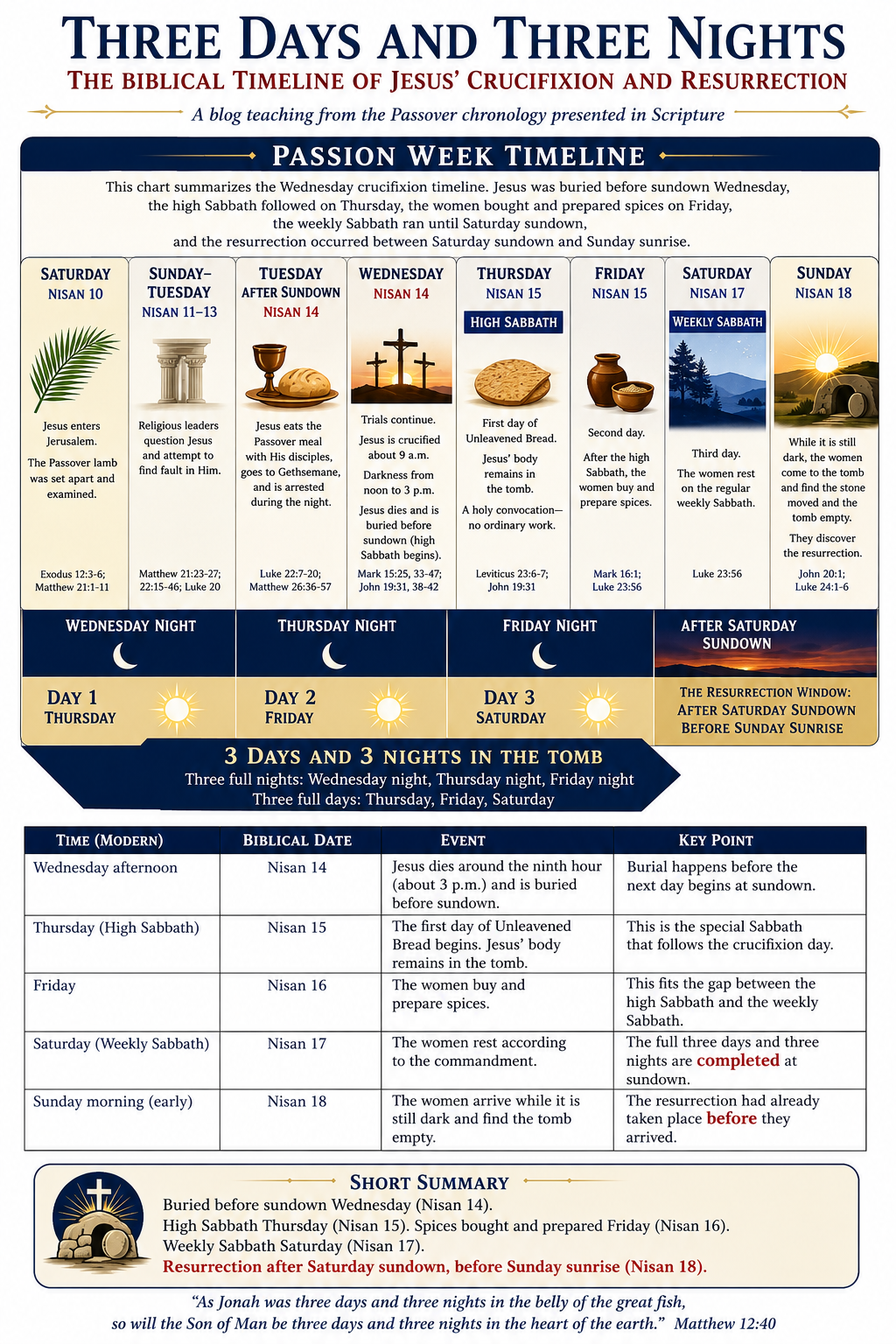
3. The Passion Week Timeline
| Day and Date | Event | Key Scriptures |
|---|---|---|
| Saturday — Nisan 10 | Jesus enters Jerusalem. The Passover lamb was set apart and examined before sacrifice. | Exodus 12:3-6; Matthew 21:1-11 |
| Sunday through Tuesday | Religious leaders question Jesus and attempt to find fault in Him. | Matthew 21:23-27; 22:15-46; Luke 20 |
| Tuesday after sunset — beginning Nisan 14 | Jesus eats the Passover meal, goes to Gethsemane, and is arrested during the night. | Luke 22:7-20; Matthew 26:36-57 |
| Wednesday — Nisan 14 | Jesus is crucified about 9:00 a.m., dies about 3:00 p.m., and is buried before sunset. | Mark 15:25, 33-47; John 19:31, 38-42 |
| Wednesday sunset to Thursday sunset | First night and first day in the tomb. Nisan 15 begins the Feast of Unleavened Bread and is a high Sabbath. | Leviticus 23:6-7; John 19:31 |
| Thursday sunset to Friday sunset | Second night and second day. After the high Sabbath, the women buy and prepare spices. | Mark 16:1; Luke 23:56 |
| Friday sunset to Saturday sunset | Third night and third day. The women rest on the regular weekly Sabbath. | Luke 23:56 |
| After Saturday sunset | The weekly Sabbath ends. The full three days and three nights are complete. Jesus rises before the women reach the tomb. | Matthew 12:40; 28:1-6 |
| Early Sunday — Nisan 18 | While it is still dark, the women find the stone moved and the tomb empty. | John 20:1; Luke 24:1-6 |
4. Three Full Days and Three Full Nights
Night 1: Wednesday sundown to Thursday sunrise
Day 1: Thursday sunrise to Thursday sundown
Night 2: Thursday sundown to Friday sunrise
Day 2: Friday sunrise to Friday sundown
Night 3: Friday sundown to Saturday sunrise
Day 3: Saturday sunrise to Saturday sundown
Resurrection window: after Saturday sundown and before Sunday sunrise
The full three days and three nights were completed at Saturday sundown. The women did not witness the resurrection itself. They arrived early Sunday and discovered that it had already happened.
5. The Two Sabbaths Explain the Spices
Mark 16:1 says the women bought spices after the Sabbath. Luke 23:56 says they prepared the spices and then rested on the Sabbath. The two statements fit together when the two Sabbaths are recognized:
- Thursday was the high Sabbath connected with the first day of Unleavened Bread.
- Friday was the day the women bought and prepared the spices.
- Saturday was the regular weekly Sabbath on which they rested.
6. Jesus Was Examined as the Passover Lamb
The Passover lamb was set apart and examined before sacrifice. During the final days before the crucifixion, Jesus was repeatedly questioned by religious leaders and civil authorities. Pilate repeatedly declared that he found no fault in Him.
Christ was the spotless Lamb. He was examined, found without fault, and sacrificed at the appointed time. See John 19:4-6 and 1 Corinthians 5:7.
7. The Resurrection and Firstfruits
The women came to the tomb on the first day of the week and found that Jesus had already risen. John emphasizes that Mary arrived while it was still dark. The empty tomb did not mark the moment of resurrection; it revealed that the resurrection had already occurred.
Jesus is called “the firstfruits of those who have fallen asleep” in 1 Corinthians 15:20. His resurrection guarantees the future resurrection of those who belong to Him.
Conclusion: Christ Fulfilled the Appointed Time
The Wednesday crucifixion timeline accounts for the high Sabbath, the weekly Sabbath, the buying and preparation of spices, the full sign of Jonah, and the empty tomb before daylight Sunday.
Christ our Passover was sacrificed for us, and He rose in victory exactly as He said. Jesus died for our sins, was buried, and rose again. The tomb was empty, death was defeated, and the promise of resurrection was secured.
Exodus 12:1-6; Leviticus 23:5-7; Matthew 12:38-40; Matthew 21-28; Mark 14-16; Luke 22-24; John 18-20; Acts 13:35-37; 1 Corinthians 5:7-8; 1 Corinthians 15:3-4, 20-23.